



Goldie
5 Mar 2026
Tommy Taft was a big character in a little body. He was a scruffy bundle of tousled blonde hair, crumpled grey uniform and dirty knees. Tommy was eleven years old in the Summer of 1940, or, as he would loudly tell you, eleven-and-a-half. In fact, nearly everything Tommy said was loud, except of course, when he was talking to Goldie. For Goldie, his shrill Cockney tones were muted to a fond, tranquil whisper. For Goldie, Tommy would do anything and seemingly, Goldie would do anything to be with Tommy too.
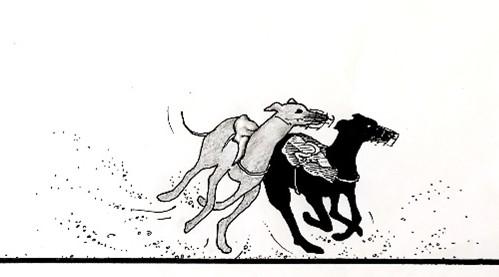
Goldie was a racing greyhound. She was fawn with a charcoal muzzle that Tommy’s dad said looked like she’d been ferreting in the coal bucket. Goldie was small for her kind, her fine frame almost bird-like, except for huge shoulders and hind quarters that Tommy massaged religiously every day. She would stand serenely on the garden path as Tommy worked his hands across the firm muscle and cooed to her. To anyone watching, it wasn’t clear who enjoyed the process more, boy or dog.
Goldie had come into Tommy’s life the previous Summer of 1939. As Europe tottered precariously on the brink of war, Tommy’s dad had one of his rare lucky days. Arthur Taft had always enjoyed a bet. In fact, several bets if truth be told and Goldie was one of his few successes. She had been owned by Jimmy Pearce, a local publican. Arthur knew Jimmy from the Walthamstow dog track and also his pub, The Golden Thread. When Arthur wasn’t working on the docks, he was usually at one or the other. They were his escapes, partly from Vera at home, but mainly from the ghosts of the First World War that repeatedly walked the corridors of his mind.
Goldie was two years old and in her first year of racing when she was given to Arthur by accident rather than design. ‘Golden Run’ as she was known on the track, was widely tipped as a future champion and had become one of the most coveted dogs in London. The beer had flowed one night resulting in Arthur and Jimmy making a sozzled side bet of fifty pounds between each other that neither could afford. Jimmy was betting on Goldie to win and Arthur against. Goldie was a clear favourite, and led all the way into the final bend where she was knocked by a bigger dog trying to come through on her inside. It meant she came in a surprise third. Jimmy couldn’t honour the bet in cash, so, never a man to break his word, he reluctantly gave Goldie to Arthur as payment in kind.
Arthur knew a bit about greyhounds. He couldn’t fail to, given how much time he spent at the track, but he didn’t really have the inclination to train a dog. Away from work his life was bets and beer, but that’s where Tommy came in. When Arthur brought Goldie home, Tommy was smitten. He loved the way she immediately leaned against him and half-closed her eyes when he rubbed her neck. She was a typical greyhound mixture of tenderness with people and a wild instinct to chase moving prey. It made for a loving dog at home that could compete with the best on a track.
Vera, Tommy’s caustic stepmother, all curlers, curses and curled lip, had shrieked about how ‘that bloody dog’ would ‘eat us out of house and home!’ Tommy had gushed back at her that he’d look after it, walk it, feed it, brush it and it would be so good that it would pay for its keep from the winnings. Vera twisted her mouth dubiously at Tommy’s enthusiastic optimism and with a sneering ‘It’ll be a flash in the pan.’ had harrumphed and shuffled her ample frame back inside, leaving Tommy wondering whether this was a short-lived love affair with Goldie. Then Arthur winked at him and with a smile said, ‘I’ve got it all worked out my son.’ And for once he had.
The garden was a good size for a terraced house in Leytonstone. It was mainly laid to lawn, hedged on all sides and had a small green shed at the end. Arthur paced out eight yards from the back hedge and carved a line in the grass with his spade, made straight with the aid of a plank.
‘What’s that for?’ asked Tommy as he stroked Goldie.
‘It’s where her pen’s going to go. She’ll live in the shed and have the bottom of the lawn to go out into.’
‘It’ll be Goldie’s run!’ laughed Tommy, and Arthur smiled, coupled with his customary wink.
Tommy was then set the task of clearing out the junk from the shed while Arthur fastened chicken-wire he’d got from somewhere round the thick hedge perimeter. He then began knocking tall posts in along his grass marker. Tommy could now see how the pen was to look, with a high chicken wire fence at the front with a gap for a gate. Arthur was a practical man who had worked with his hands on the docks most of his life, so the construction of Goldie’s new home came easy to him. Where the slatted wooden gate came from that Arthur brought out from the behind the shed with a flourish, Tommy didn’t know and knew best not to ask.
Arthur worked quickly and methodically, but when he asked Tommy to hold the posts still while he nailed the wire to it, Tommy could see the occasional tremor of his hands and the fluttering of his eyelids that he would extinguish with an angry squint after each noisy hammer blow.
A few years ago, Tommy asked Uncle Bert, Arthur’s brother, why his dad shook sometimes if there was a loud noise. Sadness crept like a shadow over Uncle Bert’s face as he answered.
‘It was the Great War son. Your Dad lied about his age and joined up at sixteen. When he came back, he was never the same. Like a lot of blokes really.’
Tommy didn’t understand what the war had done to his dad, just that Uncle Bert said it had changed him. He thought it might explain why dad drank and gambled so much and sometimes cried in the chair alone at night. Tommy could hear him sobbing and then Vera thumping downstairs, shouting at him ‘to stop his maudlin’ and that he’d got to ‘cut down his boozing and losing money at the dogs’.
Tommy didn’t like Vera who his dad had married when he was five. She was bossy and always favoured Frank, her own son who was fifteen and cruel to Tommy whenever he got the
chance. Tommy’s Ma had died when he was four from cancer. The longer Tommy lived, the harder he found it to remember her and would often look at the photograph album to remind himself. Vera caught him once and shouted at him.
‘Looking at photographs won’t bring her back y’know!’
‘Hold it still lad,’ said Arthur Taft, waking Tommy from his thoughts, as he hammered the nails in to fix the wire to the posts. Goldie looked on from a lying position with her lead hooked over the door handle of the shed. She was in new surroundings but seemed to take it in her stride. The banging didn’t seem to bother her either.
By late afternoon, Arthur proudly closed the gate on the pen, opened the shed door, slipped her lead off and showed Goldie inside. He had built a raised platform on one side and covered it in straw for Goldie’s bed and had set a water bowl on a fixed wooden stand on the other. Both father and son smiled as Goldie, sniffed all four corners of the shed, then circled in the straw and lay down.
‘Right son. Let’s leave her to bed in.’
She bedded in alright, forging a strong bond with Tommy in particular. Arthur knew what to do with greyhounds, but it was Tommy’s regular walking, careful feeding, massaging and all-round love for Goldie that meant she thrived at 24, Holby Road. Tommy was not allowed to pet Goldie inside the pen, but on returning from school each day, he’d bounce loudly down the path shouting ‘Goldie’ and out she’d trot from her shed to the gate, tail wagging and grinning as greyhounds sometimes do, before sticking her head through a gap in the gate for Tommy to stroke. Tommy could sit there for hours talking and stroking as Goldie stood with her head through the gate as if they were in conversation. In a way they were, in their own special language, one without words.
Two people that didn’t understand were Vera and Frank. ‘You’ll ruin that dog Tommy Taft.’ shrilled Vera on more than once occasion. While Frank once sneered ’Racing dogs are best kept mean.’
‘What, like you?’ Tommy fired back as Frank swiped a kick at him as he sat petting Goldie. When Tommy winced at the blow, Goldie jutted her head forward, stared fixedly at Frank, then growled.
What did Vera and Frank know about racing dogs, anyway thought Tommy? Very little was the answer as Goldie went on a winning streak of six on the bounce. Tommy went to the Saturday evening races, cheering wildly at the finish line as Arthur went to collect his winnings. By the June of 1940, Goldie had set the track record at Walthamstow and was racing at stadiums across South-East England with notable success.
Then the world changed, for the Taft’s and everyone else as the German army’s tanks and paratroopers tore through Europe and forced what was left of the British Army back to the beaches of Dunkirk. Many were saved by boats, but the Germans were now just across the English Channel and threatening to invade. Tommy heard the Prime Minister Winston Churchill on the wireless say ‘we will fight them on the beaches,’ and ‘never surrender’. He felt scared and proud at the same time, but Arthur, sitting in his fireside chair, shook his head bitterly and said, ‘What will we fight with?’.
Tommy didn’t really understand this, but what he did know was that as the summer wore on, aircraft were increasingly seen over London. If they heard the throb of an engine, Tommy and his school pals would excitedly try to spot the type, hoping it was a Spitfire or a Hurricane, then ran around with arms outstretched in imitation, mimicking the sound of the engines, before spitting out a staccato of noise to replicate the machine guns.
Soon though, the boys realized war was not a game when in late August, they heard the frightening crump of bombs falling on London; many on to the docks where so many of their father’s worked. On clear days, they could see the swirling patterns of white smoke trails in the sky that marked a dogfight, that deadly aerial dance when aircraft tried to destroy each other. Occasionally, they would see a plane spiralling downwards, flame streaming from its tail. Then they would look for the flare of a parachute in the hope the pilot escaped and when they didn’t see it, know that someone was about to die, and Tommy felt a bit sick.
Yet to Tommy’s young mind the war was as thrilling as it was frightening. It was now the main topic of conversation with his friends, though there was a worrying sub-text to their excited chatter. They knew, like everyone else, Britain had to win, or, as Frank said, ‘Hitler’ll have us speaking German and bossing us about’.
Tommy also worried about Goldie. There was talk of closing the track and if that happened, he couldn’t see Vera tolerating her if she wasn’t winning and paying her way. Then in early September, Arthur came home and gave them the news Tommy dreaded; racing at Walthamstow and anywhere else was to stop until further notice. The tracks would be closed because there would be large casualties if bombs fell on the crowd. Vera immediately and predictably started saying that Goldie would have to go. How could they keep a dog with rationing on if it couldn’t bring any money in? Tommy’s eyes filled with tears, he shouted ‘No!’ at Vera, then ran out into the garden to Goldie’s pen for comfort.
As Tommy stroked Goldie’s neck through the gate, his dad came out and sat on the grass next to him.
‘Look son. Forget what Ma’s saying. I’ve got an idea. There’s one last race on Saturday and Goldie’s odds on. If she wins, a big bet’ll tide us over.’
‘But what if she loses? It ‘appens sometimes,’ asked Tommy in worried tones.
‘She won’t. She’s our Goldie,’ said Arthur with a wink.
When Saturday came, Tommy felt the tension knot his insides and cause his hands to tremble as he stood near the finishing line amid a large crowd. He’d struggled to sleep these past few days, knowing that Goldie had to win. Then his stomach lurched as the mechanical lure began its journey towards the traps and the crowd noise grew in anticipation. The dogs soon exploded forward with Goldie springing from trap three, wearing the white vest. As a small dog, she was a ‘railer’, able to take the shortest line by hugging the inside fence, so trap one was always the best draw for her, but she’d won from three before, thought Tommy in hope.
As the greyhounds hurtled past Tommy into the first bend, Goldie was marginally ahead and made for the rails but was baulked from the left by a bigger dog on her inside. She lurched sideways and cannoned into a dog on her right and the crowd gasped as she stumbled and slipped behind the pack.
Tommy was silent for once and absently bit his finger as he watched events unfold, urgent shouts pressing in on him from all around. Goldie was behind but wasn’t done yet. Tommy nodded in relief when she regained her stride and seemed to be running unhindered once again as she chased down the pack. She was quickly fifth, then fourth, then third, as they moved along the back straight. When the dogs entered the final bend, roared on by the crowd, Goldie was closing fast on the dog in second and only three lengths off first. She seemed to be reeling them in with every stride.
Now, Tommy roared with the rest, ‘Go on Goldie! Go on Girl!’.
But the finishing line was coming up too fast and as the dogs flashed past, Tommy painfully knew Goldie was just short. Another stride, another two yards and she would have won. But she hadn’t. She was second by a head, just a fraction of a second.
Tommy slammed the perimeter board in frustration and, as he tuned to see his dad’s face in the huddle behind him, he knew then Goldie had not only lost the race, but he’d lost Goldie too. Arthur Taft mournfully shook his head at his son, his plan to keep Goldie was now in tatters.
The side-bet Arthur had with Jimmy Pearce was similar to last year’s drunken punt; fifty pounds if Arthur won, but if Jimmy won, Goldie went back to him. Tommy cried in anguish and kicked and flailed punches at Arthur when he was told. Arthur took the sorrowful blows, knowing he’d let his son down. He then buried Tommy’s tearful head in his coat so he couldn’t see Jimmy lead Goldie reluctantly away. Goldie looked round for Tommy in puzzlement.
Tommy looked blankly out the window of the train as it rocked slowly along, the rhythmic clatter of the track muted by shrill, youthful voices. He was unusually quiet and had been for the past few weeks, ever since Goldie had gone. Bedtimes had been the worst, and he’d made his pillow wet with tears whenever he thought of her, much to Frank’s amusement in the other bed, who laughed at him and called him ‘a baby’ for ‘crying over a stupid dog’.
Then, as the bombing became worse over London, Tommy had been evacuated. When children had been evacuated from the city the previous year, Tommy hadn’t gone as Arthur wanted to see what would happen first, much to Vera’s annoyance who it seemed, wanted Tommy out of the way. Arthur had called it right as there was no bombing at first and many children returned to London in short order.
This time though, Arthur could see that London was becoming dangerous. So, Tommy joined the anxious throngs at Charing Cross waiting with their suitcases and labels on to travel with their teachers to who knew where.
As he sat on the train, Tommy was a little indifferent to the whole thing. Nothing could be worse than losing Goldie and whenever he looked out of his bedroom window, down at the empty shed and the pen he called ’Goldie’s Run’, he couldn’t help but think about her. Besides, while he’d miss his Dad, he certainly wouldn’t miss Vera and Frank, nor the thought of being bombed.
They were headed to Towcester about 60 miles North of London and by mid-morning, Tommy found himself in a school hall with a score of other children, some he knew and many he didn’t. Strangers, mainly elderly couples, walked around and chose children as if they were at a sale. He was one of the last to be picked by a reed thin middle-aged woman with a searching gaze and a pursed mouth. She was called Mrs Allenby who ushered him out the hall with a proprietorial look rather than a smile as she asked him his name and told Tommy hers. Having not been too bothered at the start of the day, Tommy was now a little anxious. It was suddenly real that he wouldn’t be going home tonight, and he didn’t like the look of this woman he was going to live with one bit.
Tommy’s first impression of Mrs Allenby was sadly correct. She lived alone and was cold in her manner, having quickly informed him that with her son away in the army, she needed help with her large vegetable plot. In other words, Tommy was to be cheap labour, and she had him bending and carrying in no time, so his back and legs ached when he dragged himself up the stairs to bed that Saturday night.
On the positive side, Mrs Allenby lived in a village called Greens Norton in an old, but comfortable cottage with a large, rambling garden full of fruit trees. It was a far cry from the terraced streets of Leytonstone, there was no real threat of bombing and at least Tommy didn’t have Frank bothering him for once.
The real downside proved to be school, which Tommy started after the first weekend spent toiling in the garden. There were three new children in Tommy’s class including him and he knew one of them from school at home. His name was Terry Tucker, nick-named ‘Titch’, who was, as Londoners say, ’alright’. The newcomers were placed at the front by the strict looking old teacher, Mr Kane. A big man with a lined, craggy face and piercing stare that could reduce Tommy to the verge of tears. On the way in, when Tommy had asked one of the local boys what the teacher was like, he’d laughed and said, ‘Kane by name and cane by nature!’
Tommy tried his best at school, but found it difficult to follow, just as he often did in Leytonstone. While he liked to hear about things in the past or about nature, he wasn’t good with reading and writing and he found mathematics hard. Truth be told, Tommy wasn’t cut out for the classroom and preferred being outside doing things with his hands, but he couldn’t exactly tell Mr Kane that. When he caught Tommy looking round the room which seemed to be quite often, he delivered a swift, stinging wrap to the back of Tommy’s hand with the flat of a ruler, much to the delight of some of the local kids.
However, Mr Kane wasn’t the main issue; it was some of the other boys. At break-time, the newcomers were teased unmercifully. One boy in particular, Peter Millen, seemed to delight in mimicking their London accent. He was a big lad, round faced with a black jagged fringe and a devilish grin. He saw ‘Titch’ Tucker as an easy target which, being small, he was. Even Tommy was bigger than Titch who was thin as well as short, with gaunt, sharp features below a splash of unruly dark hair. Millen started with snide comments, but by the second week he was pushing Titch around whenever the teachers weren’t looking. When Tommy told him to leave him alone, Millen spat back the threat of, ‘You’ll get some as well daft Taft!’, with a meaty fist held in his face as a warning.
Life at Mrs Allenby’s was tolerable because Tommy had a room to himself and plenty to eat, but she was a frosty character, who, while not cruel to Tommy, clearly saw his presence as an opportunity, rather than a service to her country. He was well fed no question, but that enabled her to keep Tommy hard at it in the garden whenever he was at the house. He sensed this in her regular comments about eating everything so he could keep his strength up. Meanwhile, poor Titch looked even thinner as he seemed to be regularly denied food if ‘his people’ as he called them, deemed he had committed some ‘misdemeanour’, such as spilling sugar or salt on the table, or not folding the flannel in the sink.
Then, three weeks after being evacuated, things came to a head at school. One Thursday, as soon as they were outside in the yard, Peter Millen grabbed Titch by the neck and held him against the wall. Tommy could see Titch was gasping for breath.
‘Leave it Millen, you’re hurting him,’ shouted Tommy.
‘So what, daft Taft?’ replied Millen, suspending Titch by the throat, whose face was now mottled purple.
‘What are you going to do about it?’ sneered Millen.
Tommy was no fighter, but Millen’s comment made him snap. Arthur had taught him how to box, having done a bit in the Army, and Tommy hit Millen with a right hook that caught him flush on the cheek. Shock and pain registered on Millen’s face as he fell, releasing Titch in the process, who immediately dived on Millen, swinging wildly at him. Millen covered his face as best he could, but Titch’s fury saw him land some stinging blows before Mr Kane swooped Titch up by the elbow, as Millen dabbed miserably at his bloodied nose and pupils milled around in excitement.
An inquest followed, with all three boys stood with heads down at the front of the room while Mr Kane asked the class what had happened. Unsurprisingly, no one would speak out against Millen because of their fear of reprisals. When asked who had thrown the first punch, four pupils said Tommy had, and that Titch had followed on when Millen went down. No one mentioned Millen strangling Titch first, except Tommy and Titch himself. Mr Kane looked dubious as the accounts were given. Strict as he was, he was also fair and knew Millen was a bully.
The eventual judgement was for all three to be caned on the hand. Three each on the palm in front of the class. Neither Tommy nor Titch had been caned before, whereas Millen almost shrugged as if it was an occupational hazard. The swish, followed by the stinging slap, repeated nine times, three for each boy and leaving all three with ringing hands and tears down the cheeks of Tommy and Titch, as much for what they thought was the unfairness of it as the physical pain.
More teasing followed from the local kids at lunch time for crying, but Millen kept out their way, probably thinking about easier targets. Titch sat against the wall next to Tommy and said, ‘I ain’t ‘aving this no more Tommy.’
‘’avin what?’
‘This!’ Titch waved his arm around him, meaning the school.
‘The people I’m wiv ain’t nice either. They didn’t let me eat nuffing again last night ‘cos I accidentally dropped a cup and broke it. I’m getting out.’
‘What?’ replied Tommy, ‘How?’
They’ve got two kids’ bikes from when they ‘ad some. I pumped the tyres up and ‘ad a go yesterday. We could escape on ‘em.’
Titch’s eyes twinkled. He was only little, but from a tough East End family who’d think nothing of taking a bike. Tommy was also sick of it, both the hard toil at Mrs Allenby’s and life at the school. Besides, having lost Goldie, what did he really have to lose?’
‘I’m in Titch. When do we go?’
‘I reckon if we set off in the morning, it’ll be late afternoon before they figure we’ve gone. I’ve been near ‘ere before wiv my Uncle Charlie in ‘is removals van once. He was moving people to Towcester and told me the old London Road goes straight ‘fru Towcester. If we ’ead for Towcester and get on that, I reckon we could be ’ome in a day or two.’
‘How far do you reckon it is?’ asked Tommy.
‘About fifty miles, I reckon,’ said Titch.
Tommy grinned. At least they were doing something rather than being done to.
Goldie curled up on the straw, opposite her new kennel mate, a male brindle greyhound called Griff. It had been three weeks since she’d been at home with Tommy, and she was no longer with Jimmy Pearce either. Instead, Goldie was at a large greyhound kennel twenty miles North of London near Epping Forest. Jimmy was never the sharpest tool in the box and, while he’d won his bet and had Goldie again, the tracks were closed down because of the war. Jimmy knew this when he took the bet and thought that there’d be unofficial racing with big side bets where Goldie and his other dogs could earn their keep. He thought wrong. After a fortnight of trying to sniff out where there was some decent racing, he’d got nowhere. Greyhounds weren’t cheap to keep, so he’d cut his losses and sold his dogs, including Goldie, to a rich landowner called Jeremy Rhodes.
Rhodes kept a large greyhound kennel and could afford to keep the dogs whether they ran or not. Goldie had changed hands again for eighty guineas and Rhodes intended breeding off her during this fallow period without racing.
Goldie was usually a confident, adaptable dog and, while she had not been mistreated, she was confused and becoming anxious. Where was Tommy? Where was Arthur? She couldn’t articulate this in words but felt it just as keenly all the same. To make things worse, Griff had given her the occasional growl when she got too near, making her even more distraught. While she was confused, what she did know was that this was not home, and she needed to get out. She needed to run.
The young kennel hand approached the pen to take Griff and Goldie for their daily walk. He was confidently casual, with the practised air of someone who had done this thousands of times, so didn’t close the pen door with the locking bolt when he went in, just held it closed with his leg as he went to put leads on the dogs. Then, once his lead was on, Griff did the unexpected, jumping wildly and pulling the lad forward. His leg duly came away from the pen gate which swung inwards and Goldie saw her chance. She was out of the shed before the youth could even voice the alarm and had disappeared down the curving driveway at full speed before he emerged in a flustered panic looking for her. Goldie headed South immediately, running with an urgent and mysterious instinct straight towards London.
Tommy gritted his teeth as he pushed hard on the pedals to drive him over the hill. It was a warm, dry September day and they were weighed down with a knapsack each on their backs, containing coats, food and in Titch’s case, a big bottle of homemade lemonade. Titch appeared to make light work of the extra weight. He was a practised rider, who regularly delivered groceries from one of his uncle’s market stalls. Meanwhile, after riding for countless miles, Tommy was struggling. He gasped out to Titch who was pulling away from him,
‘Hold on Titch. Give us a rest.’
Titch pulled over at the top of the slope, looking back with a grin.
‘You ain’t fit enough Tommy. You need to get in shape mate, like me,’ he laughed.
Tommy pulled up behind him, smiling, but tired and breathless.
‘It’s alright for you. You ride all the time. I’ve never ‘ad me own bike and my arse is sore!’
‘We’re doing OK mate,’ said Titch encouragingly. ‘I reckon we’ve been riding on and off for about seven ‘ours.’ added Titch, partly proud, partly incredulous they could have ridden for so long.
‘Good job you nicked that food. The bread and jam was nice, and the lemonade,’ said Tommy.
‘Well, those people were ‘orrible to me. At least I got something off of ‘em,’ offered Titch.
‘I don’t fink I can do much more today,’ said Tommy.
With the road signs taken down in case the Germans invaded, Tommy and Titch didn’t know exactly where they were, but had taken a risk in a village and asked a man how far it was to London. He had shaken his head and said twenty-five miles, adding they’d never get there today. Tommy’s face had fallen at that, but Titch had a plan.
‘Let’s get off the main road and find somewhere to rest up. I’ve still got some grub,’ he said brightly. Tommy nodded and they pedalled wearily on, before taking a turn down a lane. Within a few minutes, Titch pointed at a barn down a side track, and they headed towards it, bumping along on the uneven surface before dismounting cautiously and scanning round them for any sign of people.
Titch stalked into the small brick structure first and his concentrated frown changed back to his usual cheeky grin when he looked back towards Tommy outside.
‘Nuffing much ‘ere Tommy.’
Tommy entered and saw a rust and blue plough next to a pile of empty hessian sacks.
‘It ain’t the Ritz, but it’ll do,’ chirped Tommy, as they went out again and moved the bikes behind the building into a stand of trees so they wouldn’t be seen. Titch pointed excitedly towards a stream carving its way between the trunks.
‘There’s water! We can get a drink n’all,’ he trilled.
Goldie had run as far and as fast as she could before her pace had slackened to a tired yet determined trot. She had covered the first mile across the fields, ditches and hedges in under three minutes. Half an hour on, Goldie was now over five miles from the kennel, though fatigue at her headlong flight was setting in. So, she lay down at the edge of a field in the shade of a tree, rib cage heaving, tongue lolling, though with ears half-cocked and alert. Her impulse to evade capture meant she kept away from any unusual noise, though her route somehow remained almost due South. Once her breathing settled, she stood, stretched forward in a low bow, shook herself down with a flourish of her tail and began her lonely travels once again, just as the afternoon sun began to drop.
Tommy and Titch had drunk from the stream, catching water from its flow in the empty lemonade bottle. They’d gathered kindling for a fire after Tommy had proudly revealed the box of matches he’d ‘found’ in the house that morning. He knew Mrs Allenby wouldn’t miss them because there were six packs in the larder.
When darkness fell and the cold enveloped them, they lit a small fire near the entrance to the barn, sat on their knapsacks and pulled their coats round them for warmth. They chattered about nothing incessantly to stop their fears of what might be in the dark find its way into any gaps of silence. Eventually, though, their eyelids began to droop. They had become too tired even to worry about what might lurk in the darkness and they shuffled inside to sleep on the sacks with a coat each for a blanket.
Goldie had kept moving at a steady trot for another two hours, soon entering the suburbs of London’s great conurbation and crossing her first major road, oblivious to the danger it posed. Goldie heard, then saw the car bearing down on her, tyres squealing as it swerved. She automatically twisted away from the sudden flash of movement; adrenaline surging, feeling the buffeting air, hearing the scrabbling tyres as she flinched her head away from the car’s bumper before she was sent sprawling. Goldie rolled, yelping through fright as much as pain. Then a horn blasted as a second car swerved around her. Neither driver stopped.
Thankfully, it had only been a glancing blow that knocked her towards the gutter. Instinctively, she moved away from the continuing noise and movement of the road and limped on to the pavement. Her breath came in terrified rasps, and she stood, pain coursing through her right shoulder, in an almost catatonic state for several seconds. The raking grazes to her hocks showed raw and red against her fawn colouring, but she couldn’t feel them yet, the bruised shoulder drowning any immediate sensation from the gravelled grazes.
The cars had given Goldie a painful, frightening lesson. As she limped on, she became canny at avoiding them, sticking to pavements and open areas whenever she could. With the sun dropping and giving way to a red-tinged horizon, Goldie continued her journey, head dipping now because of the pain in her shoulder, yet maintaining a steady, though increasingly fatigued trot.
Goldie was usually a sociable dog, with people and other canines, but her singular purpose made her blind to any attention. She repeatedly skirted round pedestrians who called to her or held out a concerned, friendly hand as she limped along with an almost desperate focus in her eyes.
Then, roughly twenty miles into her headlong flight, Goldie suddenly stopped and looked all around her. She was on a street corner near some rubble where a garden wall had been toppled by a bomb blast. She sniffed the air, twitching her nose from side to side dramatically as only greyhounds can. After a brief, but intense pause, Goldie resumed her journey, moving with a new purpose and speed, despite her wounds. She knew the smells and sights of these streets, though the surroundings seemed somehow different to before and some of the pavements were chipped and uneven, making it harder to run or walk. There was also a different tang carrying on the light breeze. It was the smell of burnt wood.
Under a mauve sky that gently lit the urban skyline, Goldie arrived at her destination. She limped jerkily on her shoulder as it stiffened, now she had stopped moving, and she could now feel the sting of cold air on her grazed hocks. Her rapid flight from Epping had also left her pads sore and in places, bleeding, though the dew on the lawn eased the pain. She listened intently, but there was no sign of life from the house which looked smaller and smelt different, though the pen was much the same. Goldie walked through its gate, now hanging askew and faced her old green shed. The door was shut, but there was a jagged hole in the wood panelling next to it about a foot off the ground and just big enough for her to jump through. She yelped as wooden splinters scraped her bare-skinned belly as she did so.
It was darker inside, though there was enough fading light from the window for Goldie to see that all was as it had been. She immediately climbed on to her straw covered ledge and was comforted by a remaining vestige of her scent. Then she circled to fashion a sleeping spot amid the old straw and settled down. As light gave way to dark, Goldie cocked her head as a haunting siren cut through the night. She might have been home, but she was also sore, scared and alone. Eventually, tiredness overtook the pain and anxiety, leading Goldie to sleep, dimly aware of the occasional muffled booms in the distance.
Tommy woke first as light crept over his face, while Titch, further in the shade of the building, lay still and asleep. Tommy yawned as he stood up stiffly, dusting dry mud off his clothes from the sacks they had slept on, and the noise roused Titch awake. It was a cold, but fine morning with no cloud and the rising sun promised another warm day.
‘Is there much left to eat?’ asked Tommy hopefully.
‘Just the crust, but we can split it,’ croaked Titch who had woken with a dry throat.
‘I’ll get some water,’ offered Tommy, taking the bottle to fill up from the stream.
The last of the thick dry crust was divided and eaten, washed down with slurping swigs from the bottle. Their knapsacks were then quickly packed and the bicycles recovered from the trees as Titch made a suggestion they would be glad of later.
‘’ang on Tommy. Let’s re-fill the bottle. We’ll need a drink later mate.’
They were soon bumping back down the track, crying out with pained oaths at the tenderness of their backsides after yesterday’s ride. Once they reached the road and, after a brief deliberation on the correct way to go, they headed once again towards London. Without a watch, they didn’t know that the time was just after seven a.m.
Arthur Taft trod wearily and blearily away from the underground station as throngs of people poured blinking through the doors into the sunlight. It had been a place of refuge during last night’s air raids once again. Arthur had spent the past week’s evenings there, ever since the house was hit. One night when the heavy, crumping sound of bombs had grown ever nearer, he’d said to Vera that they needed to get under the stairs. He’d started down from the bedroom along with Frank, when Vera had turned and said, ‘I’ll just fetch a blanket.’
It was the last thing he would ever hear her say. No sooner had he crawled into the dark space along with Frank, his world literally fell down around him. They were trapped for twelve hours in the rubble, before being pulled, choking on brick dust, from the ruins of their home. Neither were physically hurt, though both were in shock. The loss of Vera, the sudden violent destruction of the house and being helplessly contorted in a tiny space, mostly in the darkness, simply hoping for rescue, was not something that could be shrugged off, particularly for Arthur.
Just as a doctor had once told him the Great War was not something he would ever get over, but would learn to live with, being bombed out in the second World War seemed to weigh equally heavily. He also felt more guilty than bereaved over Vera, who’s cruel, sharp tongue had dripped acid on their relationship for years and he had grown to despise her.
As Arthur walked along streets carpeted in glass, thoughts of all kinds swirled in a confusing, swelling stream, threatening to drown any reason. His throat tightened, his eyelids quivered, and his hands trembled uncontrollably, just as they had in the trenches. Only two things stopped the shaking, drink or, when he concentrated on something so intently he would forget everything else, such as having a heavy bet. Arthur knew that neither did him any good and it made him grateful he had a morning shift at the docks to think about.
Goldie had woken at first light, hungry and thirsty. She gave a small wince as she stood and put weight on her shoulder. It was only a bruise, but a severe one that had stiffened overnight. She carefully negotiated the hole in the shed wall, now aware of the splinters and ventured outside, quickly spotting water in a bird bath to lap away her thirst. She was hungry though, both for food and for Tommy. With a painful limp she returned morosely to the warmth of the shed.
Tommy threw his head back in laughter as they rode into the suburbs of London. They stopped once to look at a bomb crater in a front garden and saw the blast damage on nearby houses. To Tommy and Titch, it was more a curiosity than something to fear, though the further they rode, the more damage they saw, with one street sealed off because of burst water pipes that had turned it into a shallow, muddy river. With each passing mile, Tommy knew he was nearly home as they spotted familiar sites. He felt proud of what they’d done, though a little worried about what might face them for running away.
Yet it was also funny watching Titch struggling along these last few miles. He had punctured his front tyre and with no means to repair it, they had to strip the tyre from the rim. Undaunted, Titch rode on bare metal that clattered with every turn and reverberated through his tiny body.
‘That’s Billingham Road!’ shouted Tommy.
He received a quick thumbs up from Titch as he rumbled to a breathless stop.
‘I’m only about a mile on from ’ere mate,’ gasped Titch. ‘You need to go right’.
Tommy nodded, excited but also suddenly sad. A shadow of realization that what they’d done had been special and was now ending, crossed their tired, grimy faces. Tommy felt suddenly hot and worried he would cry. Titch seemed to sense it and quickly said, ‘Be seeing ya,’ and rode away, clattering comically on the tarmac as he went. Tommy stifled the sob in his throat, smiled after him, and with a grunt of effort, rode on again.
As he neared his street, Tommy climbed out of the saddle to gain more purchase on the pedals. Despite a rumbling empty tummy, he found a reserve of energy from somewhere and sped excitedly towards home. But as he entered the road, his expectant smile twisted into a look of fear and bewilderment. The war had written its destructive story on the buildings of Leytonstone and Holby Road looked deserted. There were gaps in the terraced rows where homes had been, while some houses had been sprayed with shrapnel; their glassless windows were like dead eyes in a scarred face. And there was a strange pervading smell, a toxic concoction of sewage, petrol and charred wood.
Tommy rolled to a stop and climbed from the bicycle, pushing it as he neared his home, almost breathless with fear at what he would find and suddenly acutely aware that he might be in a lot of trouble. He could just hear Vera shouting at him now.
Then the remnants of his home came into view; a brick piled jumble splitting the terraced row in two, as if smashed by a giant hand. Tommy cried out wildly at the sight. There were no words, just a noise of anguish before a torrent of blinding tears.
Arthur heard Tommy before he saw him. His shift finished, he had returned to the house to see if there was anything more he could salvage and to avoid going to the pub at lunchtime which would only end up going one way, downhill. No word had yet been sent from Northamptonshire that the boys were missing, so Arthur was completely surprised. He didn’t at first believe it was Tommy, but the closer he got, the surer he became. When he was certain, he ran and scooped Tommy up, the bike falling with a forgotten clatter as he held his tearful son, gripping him tight. Arthur cried too. It was a release, a dam broken for Vera, for Tommy, and for himself as well. When he finally put Tommy down and held him by the shoulders at arms-length as if he needed to be sure it was him, Arthur was no longer shaking.
Goldie woke, turned her head and cocked her ears at the muffled voices from beyond the garden. She rose quickly, needing to hear better and most importantly to see. With a yelp, she jumped stiffly through the hole, scraping her belly again, but was blind to any pain as she left the pen at a trot.
Tommy and Arthur had gone to the backs of the deserted houses and then climbed over or walked through the remains of fences to see what they could salvage from the garden. Arthur said nothing to Tommy about Vera, nor that Frank had lied about his age and joined up. He also couldn’t bring himself to be angry when Tommy explained what Titch and he had done. To have ridden that far in two days surely meant they had good reason. As they reached their own garden, Tommy was talking loudly and excitedly about his travels, then stopped mid-word. They both froze with a mirrored expression of gawping disbelief as Goldie ran, as if on drunken legs towards them, tail thrashing, before jumping from one to the other, licking and crying out from both pain and happiness.
EPILOGUE 2005
‘So, Grandad, what did you do with Goldie?’ asked Paul as he lay on the carpet in front of the old man’s chair.
Tommy Taft smiled. Time had taken most of his hair and creased his features, but his eyes twinkled as he travelled back in his mind to the war again.
‘We fell lucky and kept ‘er. Well, if it can be lucky to be bombed out of your ‘ome at the same time!’
‘Where did you go?’
‘Jimmy Pearce, the local landlord took us in. He ‘ad a spare room above the pub with his two lads away in the army.’
‘What happened to Goldie?’
‘Jimmy ‘ad some sheds out the back, so she went in there.’
‘Did she race again?’
‘Well, we got her shoulder right and had her back running, though they were just unofficial races. By the end of the war, she was eight and too old for it.’
‘So, she didn’t go back to being a winner?’ asked Paul.
Tommy shook his head and looked wistfully at his grandson at what might have been, then his eyes misted as he said, ‘She was always a winner Paul. She won her most important race, getting ‘ome to me.’
This story is from the author’s imagination. Any similarities with real people or situations are entirely coincidental.
Copyright © 2026
All rights reserved.
This story or any portion thereof may not be reproduced or used in any manner whatsoever without the express written permission of the author.