



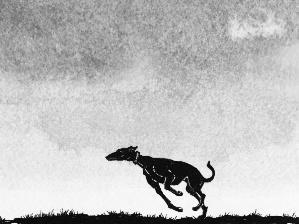
Major Black
A greyhound on the Western Front in 1916.
2 Nov 2026
MAJOR BLACK
1916
Peering over the sandbagged parapet through a periscope was always a surreal experience. It felt detached in some way, as if the high mud walls of the trench with only a slit of sky made men short-sighted as to what was above the ground. So, whenever Drake did look, no-man’s-land always seemed depressing and unsettling.
He scanned the periscope slowly from left to right across a vista of desolation. What had once been peaceful farmland was now a shell-pocked killing ground. Shattered tree stumps pointed jagged wooden fingers angrily at the sky while tangles of barbed wire were strewn on metal pickets in front of the trenches like malicious nets set for a human catch.
Drake grimaced to himself at the gruesome result of the Germans’ most recent attack. Men hung in strange postures where they had fallen or been tangled, becoming easy prey for the machine guns. As the wire moved and jangled in the breeze, it seemed to whisper, ‘Why shouldn’t you be next?’
‘Nothing new to report,’ said Drake, stifling his fear by talking to Sergeant Robertson. The tough, taciturn Scot was also standing on the fire-step to Drake’s side, though also ducked down below the parapet to avoid the attention of any snipers. Robertson simply nodded.
‘Aye Sir. I’ll stand the men down and get the orderlies to bring up the breakfast.’
The order, ‘Stand Down’ spoken, not shouted to avoid being heard by the Germans only a hundred yards away, was passed on down the trench line. There followed a jangle of equipment as the troops clambered down off the fire-step on to the slatted wooden duckboards in the belly of the trench. Drake jumped down too, grateful for the dry weatherand the lack of cloying mud. His stomach rumbled and Irons, his cheery Batman clearly heard it, remarking cheekily, ‘Not long before breakfast’s brought up Sir. Your tea’s on the table next to the cake tin.’
Drake smiled, nodded in thanks and ducked into the half light of the musty dug out. It was a wooden framed hovel four yards square with timber walls through which wet soil leached. Groundsheets hanging from the beams partitioned it into a working area on one side and two sets of bunks on the other with chicken wire mattresses. For a British front-line position, it was relatively luxurious.
Drake was keen to check the cake recently sent from home remained in its tin because of rats and mice, though Major did an excellent job of keeping the local rodent population in check. As Irons said, ‘That dog’s a better ratter than a terrier and as good a mouser as a cat. In fact, he’s better ‘cos he doesn’t play with ‘em. He’s just in, wallop, dead!’
‘Morning Major,’ said Drake with a mock salute. The big, black greyhound eyed him lazily from a curled position on his own wooden cot, complete with army blankets.
Lieutenant Harry Drake, Hal to his friends, was twenty-three years old. Romantic fiction would describe him as tall, dark and handsome with a fashionable clipped moustache, though the strain of war had etched itself in the premature lines round his eyes now sunken with fatigue and wary with fear.
When he volunteered to fight in 1914, Hal had believed like so many that the war would be brutal, but short. Instead, it had become brutal and long. Almost two years on they remained bogged down in a stalemate, a seemingly endless cycle of toil and destruction that had reduced Hal to weary cynicism.
One thing that would always brighten his mood though was Major. He was a handsome greyhound Hal had bought as a puppy to keep the rabbit population down on his parent’s extensive farm in Devon. Major’s name had come from his younger sister Kate. On spotting he had two white toes on each of his rear feet but was otherwise the colour of Whitby Jet, she said he should be called Major Black.
Major had stayed on the farm when Hal first joined up, but at a rest camp in the Autumn of 1915, Hal had brought him along. He became a great favourite of the Brigadier who liked the humour of his name and, once he saw his hunting skills, he proposed that Major Black become the Devonshire’s Regimental mascot. Hal had taken him to the front ever since and this was his third stint in the line. As Major trotted along a communication trench with Hal, they would often hear the surprise and at times, disapproval, from passing soldiers in other units.
‘Bloody big dog for the trenches,’ and ‘it’ll eat plenty too.’
After all, most dogs in the trenches were small terriers; pocket-sized hunters keeping the rats in check and alert to the sound of strangers. But as Hal repeatedly said when eyebrows were raised at the sight of Major, ‘he folds up nicely and makes short work of rats.’ The latter comment was often met with a smile or murmur of approval. Rats ate the men’s food, brazenly crawled over them as they dozed and grew fat on them if the war put them to sleep for good.
Hal bent down and ruffled Major’s neck, who licked his lips in contentment, then stretched his long legs out, before roaching on to his back with all four legs in the air as greyhounds often do. Hal called this Major’s ‘dying fly’ and tickled his tummy, causing the big hound to bare his teeth in a grin just as Irons bustled into the dug-out.
‘That tea’ll be getting cold Sir,’ he said, balancing the metal canteens of bacon and bread in each hand. Major rolled back over and looked keenly at Irons as he scented the bacon.
‘You can wait your turn Major Black!’ laughed Irons, as he laid out the food on to plates for the officers and set the cutlery, before ducking out the door again. As soon as he did so, Hal tipped a plate of bacon into a mess tin and held it in front of Major, who scoffed it down noisily from the comfort of his cot.
‘You ruin that dog Hal,’ chided Captain Brown, sitting up on his wire bed with a wide mouthed yawn. Noel ‘Sam’ Brown to his fellow officers, followed it with a smile at Major. All in the dug-out enjoyed his company, reminding them of normal life and happier times.
Though Sam was senior in rank to Hal, they were of similar age and had become firm friends over the previous year. A mutual respect had been forged in that both were stoic and cheerful amid the war’s privations yet were willing to admit to being ‘windy’ on occasion. In fact, they both found that admitting to fear seemed to lessen its effect.
While both were volunteers and as keen to win the war now as when they joined, they shared the belief that many of the senior officers were out of touch with the reality of the war.
‘The raid’s set for the dark side of dusk,’ Sam garbled through a wreath of smoke, cigarette balanced between his lips as he ran a hand over his smooth, pale features and swept back fair hair. The chain smoking seemed to calm the nerves as well as masking the stench of the latrines and decaying flesh that occasionally wafted in from no-man’s-land.
Hal nodded grimly at the news of the raid as a stab of fear knifed into him. The staff behind the lines regularly ordered raids to take prisoners for information, or just to ‘give the Boche a bloody nose and foster a fighting spirit,’ as one staff officer had announced loftily to Hal when he once asked what the purpose of a particular costly raid had been. Hal bitterly lamented that too often these trips across no-man’s-land, gave the British, not the Germans, a ‘bloody nose’ as they were often caught in the open. As for ‘fostering fighting spirit’, you couldn’t do that with dead men or the demoralized or wounded ones left behind, lamented Hal.
‘How many are going?’ he asked, while stroking Major absently.
‘Seven, including us two and Robertson. He’ll choose the other four,’ replied Sam through aburgeoning fug.
‘Make sure it includes Wagstaff,’ grinned Hal, and Sam laughed, nodding affirmatively.
Joe Wagstaff had been a butcher in Exeter who approached war with the same indifference to gore as he showed in his former trade. A giant red-haired man, he was unusual in that he thrived in a battle situation, seemingly enjoying killing and exhilarated by danger. Sam and Hal were just glad he was on their side.
‘What’s the plan?’ asked Hal.
‘Usual Bickerstaff imagination,’ replied Sam sarcastically, referring to Major Bickerstaff, who had devolved responsibility for leading the raid as usual to his Captain. It was always the same basic plan, relying more on luck in the dark than tactical thought, though Sam did his best to maximize their chances.
‘Us two with revolvers to lead, two men with rifles, including Corporal Plimmer to provide covering fire. Three armed with grenades and clubs to storm the trench and take a prisoner.’
‘Balaclavas?’
‘Yes, no silhouettes from helmets and flashlight only to be used in their trench.’
Hal nodded as Sam continued.
‘Slip over the parapet as night falls at thirty second intervals. We fan out, you go left, Robertson right and I’ll take the centre as a point of reference near the lane cut in our wire. Then we lie doggo until it’s properly dark before moving on my signal. I took a gander at their wire last night and put some markers down to guide me to a decent gap; big stones and whatnot that I can touch or find with my feet even if I can’t see. We should find it.’
‘And hope Fritz doesn’t find us,’ interjected Hal dully.
‘Wagstaff will take the prisoner with Dawson in support.’
Another nod from Hal, ‘Dawson’s reliable enough.’
The day passed uneventfully apart from a German mortar salvo just after noon. Thankfully, the small, spiteful shells landed just behind the line, though shouts of dismay and expletive laden ranting could be heard from one trench bay. When Hal went to investigate, he was confronted with three very disgruntled soldiers covered in a mixture of mud and human excrement. Major took one sniff and retreated quickly back to the dug-out as Hal quickly worked out what had happened.
‘Who was on latrine party last night?’ Hal asked.
‘Bloody Wagstaff!’ said Smithers accusingly as he wiped shit from his hand on a sandbag.
‘Didn’t you tell him it was stupid to empty the latrine bucket near the trench? The contents can be thrown back in by shellfire as you chaps know only too well,’ said Hal, trying to stifle a grin.
‘I tried Sir, but it's Wagstaff. He just laughed.’
‘I’ll speak to him,’ said Hal, as the men nodded miserably while trying to clean themselves up.
As dusk came and the company were ordered to ‘stand to’, the raiders made their last preparations, blacking their faces and hands with charcoal and checking each other to ensure all buttons were dulled. Hal loaded his pistol as Wagstaff loomed next to him with a bag of grenades in one meaty hand and a spade with a cut off handle in the other. He looked down at Hal with a glare, resentful at being spoken to earlier, or as he described it, ’lectured’ about latrine duty. Hal glared back, glad however, that his superior rank gave him some protection from the man. He was also glad the brutish Wagstaff was on the raid, as he felt the knot in his stomach twist tighter and he suddenly struggled to keep his hands steady.
As the light seeped away and the company stood down from the fire-step, Sam called theraiding party together, repeated the plan, then climbed the trench ladder and slipped quietly into no-man’s-land. The rest moved left and right, counting the seconds as they prepared to go over too.
Hal tried to slow his breathing as he fought the instinct to freeze that always assailed him prior to an attack. By an act of will he moved up the earth ramp of the sap, opened the barbed wire gateway and, once his head was level with the earth of no-man’s-land, dropped on to his belly and began crawling on the dew-soaked grass.
Major paced in the dug-out whining softly in frustration. When Hal went on raids, Major had to be tethered to stop him following, so with his lead tied to a bed frame, he paced back and forth in the gloom. Guns rumbled in the distance, like continuous, faraway thunder, though Major was oblivious to it. Curiously, shell fire, even ear splitting, concussively close salvoes did not unnerve him, but being away from Hal did.
Despite the muffling effect of the gas curtain, Major clearly heard a voice outside, urgent in tone, then a painful shriek, almost inhuman, as stretcher bearers hurried a man along the trench who’d been hideously injured by a mortar blast. The big greyhound could sense the agony in the sounds and tugged repeatedly at the leash in frustration and fear. The leash was worn. In fact, it had been used by Hal’s father years before Major had even been born. As he pulled back and forth with frantic urgency it snapped six inches from the collar.
Suddenly released, Major burst through the gas curtain and into the trench, moving left in the direction he sensed Hal had gone. He followed his twitching nose, moving quickly through two bays, ignoring the men who put a hand down to stroke him as he went past and on into the sap where Hal had entered no-man’s-land.
Hal crawled forward, snake like, towards the British wire, attuning to his environment, nerves banished for the moment by the instinctive need to focus. His movements across the ground were amplified and he felt exposed, even lying down. As he approached the British wire, he heard movement to his right, closed towards it, then touched the arm of Plimmer who whispered ‘Alright Sir,’ in his broad Devonian burr, as much an acknowledgement as a question.
Hal was just about to whisper a reply when he heard and felt quick movement behind him and as he half turned, he almost gasped as Major leapt on him in a play bow, tail wagging.
‘Shush lad,’ coaxed Hal as he gripped the remainder of the broken leash and stroked the big, black hound to a standstill, just before there was a whoosh of a flare rocketing up from the German line. It dropped lazily with a fizz, emitting a brilliant white ball of light. Hal knew the secret with flares was to stay motionless; it was movement the sniper would discern from the temporary illumination. Thankfully, Major stood calmly next to Hal and his colour melted him into the night.
As the flare landed and the light died, both men let out a breath of relief.
‘Bloody hell Sir. That was close,’ whispered Plimmer.
‘Too right,’ sighed Hal, ‘we’re in a pickle with Major here now.’
‘When Captain Brown said we had to lie doggo, I don’t think this is what he meant.’
Both men struggled to control their nervous giggling before Plimmer, regaining some composure said, ‘If we’re to go on time, he’ll have to come with us. He’s quiet and ‘ard to see bein’ black.’
‘Alright,’ said Hal, ‘Let’s see what Captain Brown makes of it.’
They crawled on, Hal holding Major by the remnants of the leash. Within a few yards though both started to gag as the smell of rotting flesh became stronger. It was from the dead caught lying on and near the British wire. Both men had seen bodies before, but the proximity of the corpses, disfigured, pungent, though largely hidden by the darkness, was a frightening reminder of the risks they were taking.
Hal crawled to Sam, leaving Major briefly with Plimmer, praying he wouldn’t start whining. Urgent whispers followed with Sam clearly furious and Hal protesting his innocence though acknowledging the situation was a mess.
After a short silence as Sam took stock, he hissed, ‘Major’ll have to come. You’re part of the plan so can’t really go back now. Let’s just pray he stays quiet for everyone’s sake!’ Hal nodded grimly as he realised the fate of them all rested on his shoulders; Major was his dog after all. As he crawled back to his position, he gave a silent prayer that Major would stay calm and above all, quiet.
Another flare burst just as he reached Plimmer. Hal froze, instinctively holding his breath as the harsh, flickering light played over them. As the flare fizzled out and darkness swallowed them again, Hal reached Plimmer and Major whose tail flicked momentarily in response. Hal ruffled his throat and took the short leash. He then removed the leather strap diagonally crossing his tunic and looped it through Major’s collar as a makeshift lead. No sooner had he done so, than the signal was given, a tap from the man next to him, and the party rose as one and made for the German line, two hundred yards away.
Hal fought the urge to stop as every step took them closer to danger, though Major’s presence, while clearly a hindrance, seemed to calm him somehow. They made steady, uneventful progress, concentrating hard on staying together and going slow enough not to fall into the shell craters or walk into anything. As they neared the German wire, all bent low to present a smaller shape just as another flare shot skywards.
They froze, hunched over, like broken scarecrows, awaiting a hail of fire. It never came and they could breathe and move again as an occasional dim flash and drum roll of shell fire in the distance accompanied the jangle of tins hanging on the German wire.
Major looked keenly ahead, ears up as they approached the spikey, spiteful forest of wire thirty yards ahead of the German trenches. Hal felt a tap from Plimmer who grabbed his sleeve and tugged him briefly to the right as a signal. Then, while Plimmer and a second rifleman slipped into shell holes, the remaining group moved to a gap cut in the German wire.
Sam had told Hal to remain with Major above the trench with revolver at the ready to covertheir exit. As he stopped ten paces from the dimly viewed parapet, Hal dropped to one knee and stroked Major repeatedly as much to calm himself as his dog. Reassuringly, once the raiders had moved a few yards towards the lip of the trench, they were invisible once again.
Then a voice from close behind cut through the night and Hal’s stomach lurched.
‘Remain still and put your guns down. You are surrounded,’
The terse commands were in accented English, as the rattle of rifle bolts echoed out and flashlights lit the scene of capture in sharp pencils of light. Hal’s shoulders slumped in resignation. He put his revolver down and raised his right hand while holding Major’s leash in his left. Hands were quickly on him, hauling him roughly to his feet. The makeshift lead holding Major was yanked from his grasp, then he felt a hard smack to the back of his head. Major too yelped in pain as he was kicked from behind. But the yelp was followed by a snarl and a human cry of pain as Major bit into the hand of his attacker causing him to drop his flashlight. In the ensuing confusion Hal took his chance, barging the German nearest to him and knocking the torch from his hand, before running for the gap in the wire and calling Major on.
Behind him, he heard a grenade explode, shots and a loud Devonian shout. Wagstaff had typically decided to make a fight of it whatever the odds. It gave Hal a small window of time and he sprinted for the gap in the wire. A stripe of light briefly played over him as one of the flashlight beams searched to and fro, followed by a crackle of firing as Hal ran through the wire gap. Major sprinted past him, makeshift lead trailing, thankfully failing to snag on the barbs to left and right.
‘In here Sir!’ came a desperate shout from Plimmer, just audible among the staccato sounds of rifle fire. Hal spotted the shell hole and jumped in just as another flare split a jagged course of light in the darkness. More shots rang out as Hal put his head down and creased his eyes shut. He was fearing for his men, for Sam and for his dog, though as the flare extinguished and the curtain of darkness fell once again, he felt Major’s cold nose on his cheek, then his tongue, licking playfully at him. Even amid the terror and danger he couldn’t help grinning. Hal gratefully grabbed the remnants of the leather strap and pulled Major lower into the crater. Rifle shots whined over them, before the rattle of a machine gun joined the deadly chorus, then the British line opened fire, creating a concert of hate.
Hal spoke close to Plimmer’s ear, ‘no point moving until the shooting stops.’
Hal could just hear Plimmer’s affirmation with a barely audible, ‘Sir’.
As they lay in the crater, Hal cradled Major against him. Despite the cacophony of sound and flashes from flares, the big greyhound lay still, head on Hal’s shoulder, eyes brimming with affection. Next to him, Plimmer caught a glimpse of man and dog by the light of a flare and smiled to himself.
Eventually, the firing died down, and the night was quiet again. Hal risked shining his flashlight directly on to his watch at the base of the crater. It was almost eleven o’clock. They’d been in no-man’s-land for over an hour with probably twenty minutes in the crater, though it felt more like a day. Hal gave a wry smile as another flare went up; the Germans trying no doubt to catch anyone making their way back to the British line. Then his face fell as he heard the crack of a rifle, followed by a thud as a sniper caught someone in the open.
After an agonizing wait, Hal spied his watch carefully again. Another twenty minutes had elapsed, so he touched Plimmer’s arm. Emerging from the crater with Major on a short lead, the two men moved at a fast, bent walk, feeling acutely vulnerable.
As they reached their own wire, they lay down before Hal spoke clearly, though without shouting, 'Lieutenant Drake and Corporal Plimmer, with Major Black, coming in.’
‘Password!’, demanded a sharp voice.
‘With,’ said Hal. A word often used because few Germans could pronounce the W.
‘Take it steady through the wire, Sir.’
Hal felt an almost overwhelming sense of exposure in the final strides to the trench. Heart hammering, he prayed the curtain of darkness wouldn’t be torn again by a flare as he walked Major to the parapet. Helping hands reached up to lift Major down as Hal and Plimmer scrambled down a ladder, illuminated by a lamp on the fire-step.
‘Any others behind you Sir?’, asked Sergeant Silverwood.
Hal shook his head, grateful the dark hid his tear-filled eyes as he held Major to him and began to visibly quake.
Hal and Major returned home a fortnight after the ill-fated trench raid for ten days’ leave. It was the first time they had set foot in Britain in over six months. Hal had written to Noel Brown’s parents, explaining as best he could what had happened and offering the hope ‘Sam’ could be a prisoner. He wrestled with the idea of visiting them, but the truth was, he simply could not face them.
He scoured his mind repeatedly about whether Major’s presence or his own mistakes hadcaused the raid to fail and men to die. Plimmer sensed this in the days that followed and told him they’d just been unlucky. Thankfully, it didn’t seem to register with Major Bickerstaff that Major may have compromised the operation, and the Brigadier, for whom Major appeared to do no wrong, didn’t raise it either. The official view was seemingly just another raid gone wrong, but Hal missed Sam terribly and guilt weighed heavily upon him.
Visiting his parents was a mixed blessing too. Hal really appreciated seeing them again as well as the comfort of home with a range of food and lie-ins in a soft bed, though he hated the dinner parties where his parents had been keen to show off their ‘returning hero’. It was the last thing he felt, after all. The failure of people at home to understand what the war was likemade him angry, but he didn’t have the heart to tell them about the reality. Instead, he bottled it up while pouring spirits down his throat in ever greater quantities. Even his father, a man always partial to a large whisky, had noticed Hal's copious consumption. He worried about his son but couldn’t find the words to say it.
Hal’s only solace was with Major, walking the fields, seeing him run without a care. At these times in the early Summer sunshine it was as if there was no war. Yet reality and his demons were never far away, and the days of leave were soon spent. Hal and Major were all too soon on their way to France once again. As he met up with fellow officers at St Pancras, there were rumours the allies were readying for a ‘big push’ near the town of Albert astride two rivers that Hal had never heard of, the Ancre and the Somme.
Hal walked through the trench with Major at his heel. It was deep and well maintained with a thick layer of sandbags crowning both sides. The duckboards were thankfully dry too, so walking was easy, though Major had to tread carefully so his paws didn’t drop in between the slats. Hal acknowledged each of his men in turn, a word here, a nod there, a reassuring clap on the shoulder. Hal mused that the returning smiles and murmurs seemed to be directed as much towards Major as to Hal. The big hound was enjoying the affectionate pats and strokes as he nuzzled hands and swished his long tail and Hal didn’t mind who boosted morale, even if it was only momentary.
He looked up to see a crimson hue to the darkening sky as the sun dropped, knowing the next time it rose, they’d be going over the top. He’d been on numerous raids, but tomorrow would see the British army, along with the French, emerge from their trenches on a scale never seen before. Over two hundred thousand men on a twenty-mile front would attack the German lines that the British artillery had been pounding for over a week.
Hal reflected on the build-up. Many senior officers appeared bullish. For them, this was the moment, the turning point in the war and the end of the stalemate. What was left of the German army in Picardy after the artillery bombardment would be mopped up by the infantry or forced beyond the trenches into open country and hunted down by the cavalry currently poised and waiting behind the lines.
Yet Hal wasn’t convinced. In a lull in the bombardment three nights before, he’d crawled into no-man’s-land with his new Captain, Ed Toomey, who’d replaced Sam, now thankfully confirmed as a prisoner of war. While Hal’s old friend was never far from his thoughts, Toomey had quickly impressed him and the men with his combination of efficiency, humanity and bravery. He led by example and insisted his junior officers like Hal did the same; hence it was them reconnoitering and not their troops.
This time Major was on a new lead and under the personal care of Irons, who fed him bacon scraps while Hal and Ed lay silently in the craters and tall grass near the German wire. There was enough moonlight to see there were wide gaps in places where the artillery had blasted the wire aside for the infantry to pour through. But in other areas the wire was intact, or, having been blown in the air, had settled in a tangled and impenetrable mass. More worrying still were the sounds from the German lines; voices muffled by the earth, though loud enough to carry from their dugouts. At one point they even heard singing and laughter.
On their return, they went straight to Bickerstaff’s dug out, where he sat at his table, brandy glass in his right hand. Ed told him that their target, Mametz village, would be ‘a very tough nut to crack without more gaps in the wire.’ Hal backed him up, stressing there were clearly still plenty of Germans alive. If they were to attack at a walking pace at 7.30am in broad daylight, as they’d been told to, they’d be easy meat as men crowded to go through the few gaps in the wire.
Bickerstaff pursed his mouth in impatience and irritation, barely hearing them out before delivering one of his lectures, reminding them of ‘their duty to lead by example,’ and to ‘show moral courage at this defining point in the war.’ Hal bit his lip to avoid smirking at such hypocrisy and he bent to stroke Major, hiding his face.
Bickerstaff continued, warming to his task. ‘And you seem to forget the bombardment has now been extended by two days. Those guns are near as dammit, wheel to wheel. It’s like the day of judgement when they’re firing in concert. Two more days of that and there won’t be a rat alive, let alone Germans. I also have it on good authority they’re focusing on widening the gaps in the wire as well. Your fears are unsubstantiated gentlemen.’
Hal couldn’t help himself. ‘The bloody shell fire’s lifting the wire up and dropping it back down more often than it’s cutting it! If the Germans have survived five days of bombardment, what difference will two more days make? They’re underground for God’s sake. If we walk across, Fritz will have set up his guns and easily find us as we look for gaps in the wire. It’s bloody suicide!’
By the time Hal was finished he was shaking from fear and fury as a tense silence ensued. Bickerstaff pursed his mouth, Ed looked down and Hal glared defiantly while Major cocked his head and raised his ears quizzically, sensing the discordant mood.
‘I think you’ve said more than enough Lieutenant,’ snapped Bickerstaff, ‘I would also suggest the presence of that dog in the line has made you too sentimental.’
They filed out with Major in their wake and Hal nodded to Sergeant Robertson who was doing the rounds of the trenches, checking the sentries were awake. His knowing expression showed he’d heard the exchange with Bickerstaff and he bent forward, stroked Major, and said loudly, ‘what a fine Major we have Sir. Aren’t we lucky?’
Then, with another ruffle for Major and a wink for Hal and Ed, he moved into the nexttrench bay. The two men simultaneously shook their heads, grinning sardonically.
Two days had passed since the spat with Bickerstaff. They were filled by boredom and growing fear to the torturous accompaniment of an almost constant drum beat of fire. The repeated pounding seemed to dull the senses while heightening the anxiety, a state Hal struggled to understand, just as he marveled at Major’s indifference to the din. Occasionally, the Germans retaliated with their own artillery and stretcher bearers rushed past with their resulting grisly cargo.
All this time the trenches were steadily filling with soldiers. On several occasions Hal had to jump onto the fire-step with Major leaping up behind him to allow a new column of troops to move into position. They wore full kit, at least sixty pounds of equipment, and their haversacks glinted as the last of the light played on the metal triangles pinned to them; the novel idea being their metallic reflection would enable the commanders to see how far they had advanced.
So much effort had been made, so many men involved, so many guns firing that Hal desperately wanted to believe that Bickerstaff and the old fire-eaters at HQ were right; that they would prove an irresistible force. Yet his reconnoiter into no-man’s-land with Ed left him in doubt and, like so many others, Hal wondered whether this was his last ever night.
He ducked into the musty space, where Ed’s sparse auburn hair shone in the glow of a paraffin lamp that played milky light through a crystal glass tumbler in his hand. He quickly drained the glass before reaching again for the whisky bottle.
‘Care for a tot old man?’ Ed asked cheerily, though the tremor in his hand as he poured gave away the lie in his voice.
‘Thanks,’ said Hal as he sat down wearily on his bed and called Major to him. He climbed alongside Hal, rested his head on his lap and closed his eyes in satisfaction as he was stroked. Hal gulped the whisky down and offered up the empty glass to Ed for an immediate refill.
‘Taking it steady I see,’ Ed slurred with a raised eyebrow.
Both knew the score, dull the senses enough for sleep, but not too much to function should the need arise. Hal was tired and half-drunk, but sleep eluded him for what seemed a long time. When he woke with a dry throat and stiff neck, Major had done something unusualhaving climbed on to Hal’s bed and nestled in the crook of his legs with his head on Hal’s thigh. Hal smiled and then realized Ed in the opposite bunk was smiling too, though it seemed to Hal like a rueful, rather than a happy grin.
Outside, the gunfire they’d eventually snored along to now seemed heavier than ever. Ed could reach the gas curtain from his bed and squinted through a gap.
‘Lovely day for it Hal. Let’s shape up eh?’ he shouted, though was barely audible.
Hal coughed and the movement woke Major who gave a tongue-lolling yawn. As Hal watched Ed strap his Sam Browne on and adjust the holster for his revolver, the enormity of the day was dream-like and terrifying.
Then Irons thankfully doused Hal’s growing sense of fear as he breezed in carrying plates of hot bully stew. Strong tea followed and Irons inclined his head as a silent question to Hal to save him shouting. Hal nodded in reply and with a smile, Irons tipped the remainder of last night’s whisky into the brew.
Outside, the roar and thump of the guns grew in intensity and Hal’s stomach pumped bile into his throat in protest at the shuddering, ear-splitting violence.
The dug out seemed to shake as he stood, and as Ed struck a match to light his cigarette, the flame guttered, then died as if it was too frightened to light. For the first time, Hal saw Major cringe in fear, ears flat to his head and mouth pulled into a frantic grin like the imitation of a madman. He put his lead on in case he bolted in fear, before holding him, stroking softly and rhythmically until Ed ducked back into the dug-out beckoning him outside because speechwas no longer audible.
As Hal stepped out, he could almost feel the shells passing over, like the furious power of a close-passing train rushing through a station. The men huddled down on the fire-step, occasionally flinching as a shell dropped short and rocked the trench, sending chalky earth cascading down the sides.
The only consolations being the Germans were getting it worse, and the pleasant diversionof the pre-attack rum ration was being distributed. Sergeant Robertson cradled the large earthenware jar, pouring a generous measure of the inky rum into each soldier’s mess tin.Men nodded their appreciation at the liberal pouring and Robertson’s unusual generosity was matched by his typically stern features softening as he served them. It was the reassuring smile of a father looking out for his boys.
Then the barrage stopped. Even though Hal knew the bombardment would cease at 7.20am, the sudden silence was eerie. Birdsong could be heard amid the rattle of equipment and murmur of voices as the soldiers began to prepare. Most were quiet, pensive, though the terror was clear in the eyes of some. As Hal moved along the trench with Major, encouraging his men, amid the responding nods he saw one soldier with his eyes closed mouthing a prayer.
As the minutes ticked by, the tension grew. Scaling ladders were set up, though Hal and Ed moved to a sap that would provide them with a gentle ramp into no-man’s-land, enablingthem to be out first to lead their men forward. Ed lay at the end and raised a periscope. He shook his head almost as soon as he looked through it and Hal knew what this meant; the wire was not sufficiently swept away. With his hand shaking, Hal looked at his watch once again.
When it read half-past-seven, shrill whistles sounded followed by a flurry of movement as the attack began. Yet Hal seemed rooted, legs frozen, before Major pulled him forward up the ramp on to the open grassy ground.
Lines of khaki figures extended to left and right as far as the eye could see walking steadily, rifles at the high port, bayonets pointing diagonally upwards. As they moved beyond the gaps in their own wire, Hal heard Sergeant Robertson bark an instruction.
‘Keep it steady lads,’ ensuring they advanced in line.
Then the cruel metallic patter of a machine gun rang out and men began to fall. Some toppled silently, others screamed, a few were spun round like broken puppets as they went down. He saw Robertson, the toughest man he knew, falter before crumpling at the waist, his legs suddenly crimson.
The grass was knee high in places and Hal could see the bullets cut their deadly path through the stalks. Yet Major kept pulling him forward and Hal, almost trance-like, kept going. Ed beckoned the dwindling numbers on, mouth open, shouting orders made silent by the rapid fire.
Then he jerked backwards and was swallowed by the grass. Major pulled anxiously towards the spot, ears up, straining on the lead, his glossy coat glistening in the sun. It was beauty amid the horror, and the last thing Hal ever saw.
EPILOGUE
It was a small cemetery compared to many others in Picardy; three rows of white headstones surrounded by a low wall jutting into a field of wheat. The pupils filed through the gate respectfully, almost reverentially as if entering a church. Voices were quiet as they trod carefully among the graves, reading the inscriptions, noting the ages, nineteen, twenty, only a few years older than they were.
Mrs Coombs stood expectantly near a grave at the far end, guidebook in hand, while three other teachers acted as sheepdogs, maneuvering their charges towards her. The party stood in a horseshoe, becoming hot under a cloudless blue sky as Mrs Coombs gave the narrative. It was the familiar, sad story of the Somme. Of an attack gone wrong and casualty figuresdifficult to grasp; nearly twenty thousand dead on the 1st July alone and a further thirty-seventhousand wounded. Mrs Coombs said, ‘think of a football stadium of fans all killed’. It didn’t seem to capture it, somehow.
But then she asked Sam to step forward. He did so shyly, like many fifteen-year-olds, pushing the mop of dark hair back from his face self-consciously. He stuttered a little at first, but when he looked at the headstones soon found his rhythm and as he brought the characters to life, the group journeyed back with him into the past.
Sam stood taller as he proudly talked about his Great Grandad Noel who died long before he was born. Noel had fought in the First World War and Sam held up a large photograph of a smart, serious looking young man in army uniform. He pointed out the leather strap slanted across the chest and explained it was a ‘Sam Browne’, which had given his Great Grandad his nickname.
He told of how Great Grandad Noel was captured in a trench raid gone wrong in 1916 and spent over two years as a prisoner in Germany. Apparently, Noel had often talked about his friend killed in France whose grave he visited many times before he became too frail to travel.
Sam then produced a second photograph. It was a group shot of three rows of soldiers. He identified his Great Grandad, seated in the middle row and then the young officer next to himwith a moustache holding the lead of a glistening black greyhound, tongue lolling, proud head erect, standing among the cross-legged, smiling faces of the front row.
‘That man next to my Great Grandad,’ Sam said, ‘is buried in front of us.’
Collectively, silently, they read the headstone:
Lieutenant
H.DRAKE
Devonshire Regiment
1st July 1916 AGE 23
Next to it was a smaller stone, a rectangular white tablet set in the grass.
Major Black
Devonshire Regiment
1st July 1916 AGE 6
With a lump in his throat, Sam explained who Major Black was. How he’d been found in his master’s arms in no-man’s-land, then buried with him.
Two photographs and the story of a man and his dog told from the heart took them all beyond the facts, figures, memorials and cemeteries. The students now saw faces, not headstones, young men moving dutifully across the fields around them accompanied by a black greyhound, ears cocked in excitement, moving ever onward with his master.
This story is from the author’s imagination though set in a historical context. Any similarities with real people or situations are entirely coincidental.
Copyright © 2026
All rights reserved.
This book or any portion thereof may not be reproduced or used in any manner whatsoever without the express written permission of the author and illustrator.